
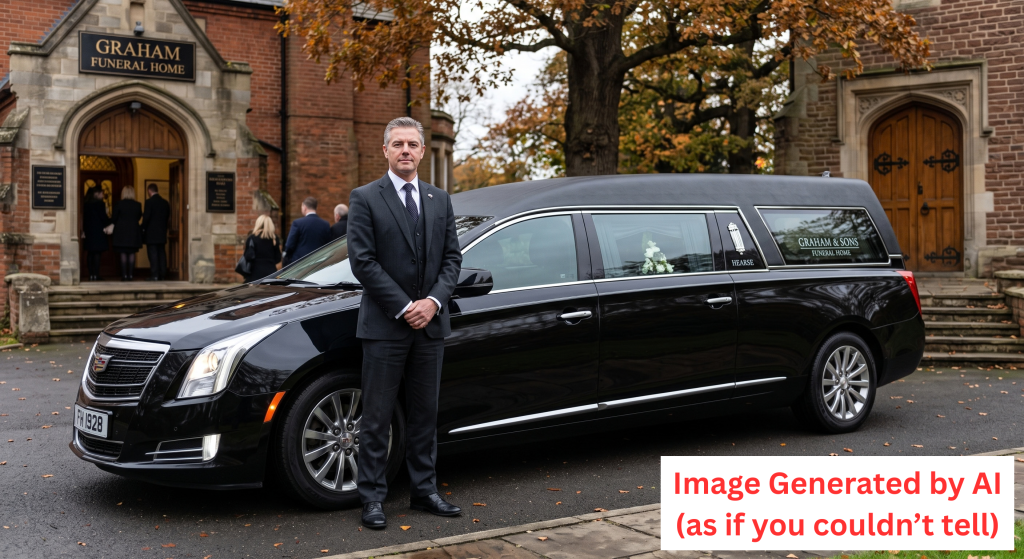
Social Media is Filled with AI Slop from Funeral Homes
AI slop is bad for your business and bad for your customers. Yet so many funeral homes are churning out low-quality content that ultimately hurts their businesses and ruins their brands. What looks like a quick and easy way to create new content actually poses real reputational risks for your funeral home. My focus here is on the use and abuse of AI on social media, but the lessons are broadly applicable.
What is AI Slop and How are Funeral Homes Using It
AI slop is a catchall term for low-quality, low-effort material that is created using generative artificial intelligence. You might recall the viral “Challah Horse” that was an AI-generated photorealistic image of a horse made out of bread that went viral in 2025. There were also the AI-generated Coca-Cola ads in 2024 and 2025 that featured typos and sparked a backlash among consumers. Now you can’t spend five minutes on social media without seeing a stream of AI images of menus at local restaurants or infographics that were churned out at the push of a button.
Funeral homes are using AI content in two main ways, one much more damaging than the other. The first is in graphic design. For example, a funeral home is having an event and they create a post (or poster) that is largely or entirely AI-generated. As long as the information is correct and the graphics make sense (no people with three arms, that type of thing), this type of content is generally fine. You might argue on aesthetic grounds that it would have been better if a real graphic designer put together the post, or you might think an AI post is lazy. And in a perfect world the funeral home would have probably preferred to have had a real graphic designer and photographer create their content for them. But that can be expensive and time consuming and take away from the real work of running the funeral home.
The second way funeral homes are using AI content is a real problem. Realistic (or almost realistic) photos and videos of AI funeral directors pose reputational and legal risks to your business. Realistic AI that is not disclosed can get you kicked off a platform. For example, Facebook requires you to label realistic content that is made by AI. Failure to do this can result in your account being suspended or canceled. You’ve spent years building a social media following, you don’t want to lose that. There are also potential legal issues depending on what the AI content says. For example, if the AI person presents themselves as a funeral director at your funeral home or presents incorrect pricing and services, this could expose you to accusations of false advertising.
The biggest problem, however, is the reputational harm posting this type of AI slop can do to your business. Full-service, traditional funeral homes differentiate themselves from direct cremation providers with their emphasis on service and personal touch. A fake video of a fake funeral director is about as far from personal as you can get. At a basic branding level, using this type of content makes no sense. It erodes the trust you’ve spent years or decades building. A lot of these videos fall in the uncanny valley where something seems a little bit off and creepy. This poses a specific risk to funeral homes since a decent percentage of the population finds death a bit creepy. No funeral home wants to come off as creepy and weird, yet these videos do just that.
When to Use AI
None of this should be taken as a manifesto against the use of AI. I use AI all the time for a variety of tasks, but I try to be thoughtful about my use of it. For example, we’ve found real efficiencies with using AI tools in automating certain marketing and reporting tasks. This saves us time and saves our clients money; that’s a win-win situation. On the other hand, some things require a real human touch. While I use AI to aid in research and data analysis, when I actually write something (like this) it is 100% human. I enjoy writing; the writing process helps me work through my ideas; and I think it’s a disservice to my readers to have them read something unoriginal that ChatGPT or Claude churned out.
There are tons of great ways funeral homes can use and are using AI in their workflows. This back end automation is increasingly baked into every piece of software your funeral home uses. I’m not bothered by some AI design for informational uses and events as long as it has been edited by a real person. If clip art or a Canva template will do the job, having AI create a similar product isn’t a huge deal in most cases. Using AI to edit images in the ways you’d use Photoshop is also a practical choice. The use of AI to write obituaries is a contentious topic, but it probably makes sense to offer it if you’re a low-cost provider.
So when shouldn’t funeral homes use AI? Don’t use it to replace personal interactions or create representations of people. One of the best things a funeral home can do on social media is to show off their real people doing real things in the funeral home and in the community. Don’t make images or videos of events that didn’t happen or you weren’t at. (This ought to be obvious, but not everyone has gotten that memo.)
A Three-Tiered View of Content Quality
The absolute best content is based on original collateral. That means pictures and videos of your people and business taken by you (or a photographer or videographer that you hired). Nobody else has this content. Nobody else has your staff or facilities. The top tier of content is based on original material. If you’re a high-end brand, the vast majority of your social media content should involve original collateral.
The middle tier of content uses stock images and materials. A good designer can take stock images and turn them into something truly original. (A shocking percentage of book covers are based on stock images, but they’re used in original ways and have been carefully designed. They don’t look like a stock image with the name of the book slapped over it.) Don’t just take a stock image and use it. Tweak it, add other elements, make it original, add your branding to it. There are tons of situations where social media content based on stock images is perfectly acceptable, though a social media presence built entirely on posts made from stock images will make it hard to personalize and differentiate your brand. It’s best to mix these in with content built on original images.
The lowest tier of content is AI generated. The worst of this is slop. Better versions involve AI elements and additional design work. AI content runs the risk of looking generic and lazy, which are not terms most funeral homes want to be associated with. Full service providers should use AI content sparingly and never use realistic AI images of people.
Content exists on a spectrum from completely original through stock images to completely AI generated. From a brand perspective this correlates well with market positioning, from high end down to the lowest cost providers. That is, a high end funeral home’s social media posts should primarily be original content, some posts based on stock images, and very little completely AI content. Lower end providers will likely skew to the bottom end of this spectrum. But that also provides an opportunity: a low cost provider with a ton of original content can stand out against their competitors.
What to Post Instead of AI Slop
I understand why funeral homes post AI content. It’s fast, cheap, and easy. And it seems like an attractive way to produce content that you might not be good at making. Don’t fall into this trap. Almost every funeral home says it’s their people and service that set them apart. This is a real “show, don’t tell moment.” Show off your people. Highlight what they’re doing. Make it known how you’re involved in the community.
Few funeral directors get into the industry because they love being in front of the camera. I can empathize with that. Churning out an AI video of an attractive funeral director with good lighting talking about your funeral would look to be a great way to gain a bigger social media presence without having to actually be on camera. The problem is that it comes across as fake and impersonal.
Instead of posting slop, create original videos even if you think they look worse than the AI videos you’re seeing. This might seem counterintuitive, but the authenticity is more important than the production value. This might not be the most fun you’ve had all day, but it isn’t as hard as it sounds. Take a few minutes to write a short (less than a minute) script, make sure the lighting is good, and then record yourself on your phone. And then record it ten more times if that’s what it takes. Producing a decent quality video, with adequate lighting, and a script that makes sense should take less than thirty minutes the first time you try it. Over time you’ll get faster and it should feel more natural. The families you serve would rather see a real, if imperfect, funeral director talking to them than a perfect, but fake, AI funeral director.
If original video seems like a bridge too far, start with photos of your staff and facilities. Show off the real people at your funeral home. This type of content performs well, and it helps to differentiate you from your competition. In a world increasingly inundated with synthetic content, lean into real people.
The temptation to embrace new technologies is real and understandable. For all its ills and potential ills (job loss, data centers in your backyard, the destruction of humanity, etc.), AI offers legitimate opportunities for funeral directors to improve their operations. Amid all the hype and allure of the new, don’t lose sight of what is at the heart of running a funeral home: real people serving real members of your community. Make sure your social media posts reflect those values.